Saturday, June 13, 2015

Just Look at the Flowers

Just look at the flowers...

Sorry, the Reapers are flowering and I just had to do it.


The top one with the actual open flower isn't the skull Reaper, but the bottom two are, and you can see its not far behind despite it's smaller size.

On a side note, the Buddha bonchi has leafed out it's canopy nicely, so I did some shaping on it while I was out.


One of the spots I trimmed off included a pod, but I think it was far enough along that it will finish ripening on it's own.


If it doesn't, well no great loss.  It wasn't an iconically shaped pod for this plant, and I don't actually eat the pods from this one anyway, so worst case scenario is I sterilize the seeds in the microwave and toss it in the composter to feed the next generation of peppers.

Wednesday, June 10, 2015

Mother Nature: The Ultimate Showoff

As those who have been following the blog know (is anybody following this thing in real time?), I am currently growing four Carolina Reaper pepper plants.  One of them I have been shaping and trimming and growing over the skull in an attempt to make an impressive bonchi out of it.  I'll show the update on that one first.

Last entry I showed where I had dug the whole thing up and re-positioned the roots to spread them out better, and it stayed droopy for quite a while afterwards.  I may have caused it more trauma then I really meant to, because it took this long for it to recover.  But, its doing fine now, so I went ahead and started the first phase of an in-ground pull-down.


As we saw with the Laughing Buddha Peter Pepper last time, these roots do not like to grow large on their own.  If left to itself, a pepper plant will just put out mass amounts of thin feeder roots, which is great for the pepper, not so great for our bonchi.  The Laughing Buddha is in it's second summer now, and you saw how thin the roots at the bottom still were.

So, I gently scooped some soil away, and used a cup to pour water from the rain barrel over the roots to wash the soil away from the crown of the skull.  For those that rememeber how this started on the Buddha, here we go again, but for real this time!

---

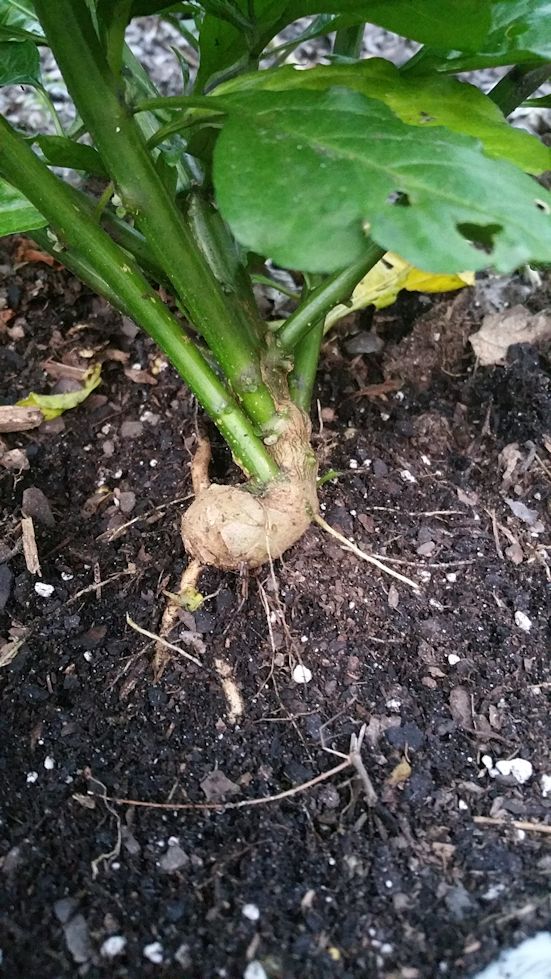
And remember I mentioned the other three Reapers?  The ones I've been letting grow however they want, mostly for pod production but also as emergency backups for the guy above?  All three are now much larger than this one as I haven't been messing with them, and two of them have the pretty standard trunks you'd expect to see on a pepper.

The third one though?  I found this today.


Lets look a little closer at that.


Its a little hard to tell from the pictures, but left entirely on it's own with no coaxing or training, and it has tied itself practically into a perfect knot and started producing some large surface roots.

Just good old Mother Nature going "Uh huh, I see what you're trying to do.  Now let me show you how a pro does it."  I concede defeat, Mother Nature, you made a much more interesting trunk than I did without even trying!

Am I disappointed?  Hell no, I'm thrilled!  Just look at that thing, it tied itself into a knot!  Just because it isn't growing over a skull right now doesn't mean it won't make a great bonchi at the end of the season!  And if something happens to the skull one, its great to know I've got such an amazing backup just waiting in the wings.

Just goes to show you, no matter how hard you work at making something, sometimes the best answer is to just sit back and keep your hands to yourself.  Life will find a way... to show you up every damned time. :D

Saturday, May 30, 2015

Finally, Something Happens

Weather forecast for today was fairly cool (relatively speaking), mostly cloudy, and 0% chance of rain.  Perfect weather to work on some bonchi.


As you can see, the peppers are finally starting to really take off.  The ones not sitting on a skull are still doing better, but the little guy is starting to catch up.  Too bad about what we're about to do to it...

(I'm baaaaack!)                                                   

After trimming some lower branches to expose the trunk, I dug it up to work on the roots.  I'll have to admit, I had hoped to have more to work with at this point, but there's enough.


Hard to hold everything in place and still take pictures.


Pressed some roots into the eye sockets so that they'd help hold it in place later on, pushed some into the sides of the open mouth, and all around spread things out.  Its kind of hard to see in the photos, but the main central root was curling nicely around the nose bone.


Got everything replanted, and you can clearly see the bends that the tie ropes caused in the trunk.  Didn't come out quite the way I had hoped they would, but we'll see how it ends up looking later on.


Next up, the Buddha Bonchi.  As you can see it's canopy has started filling out nicely, and the branches have lignified, so they should hold their shape after I take the stakes away...


And they do!  Perfect!


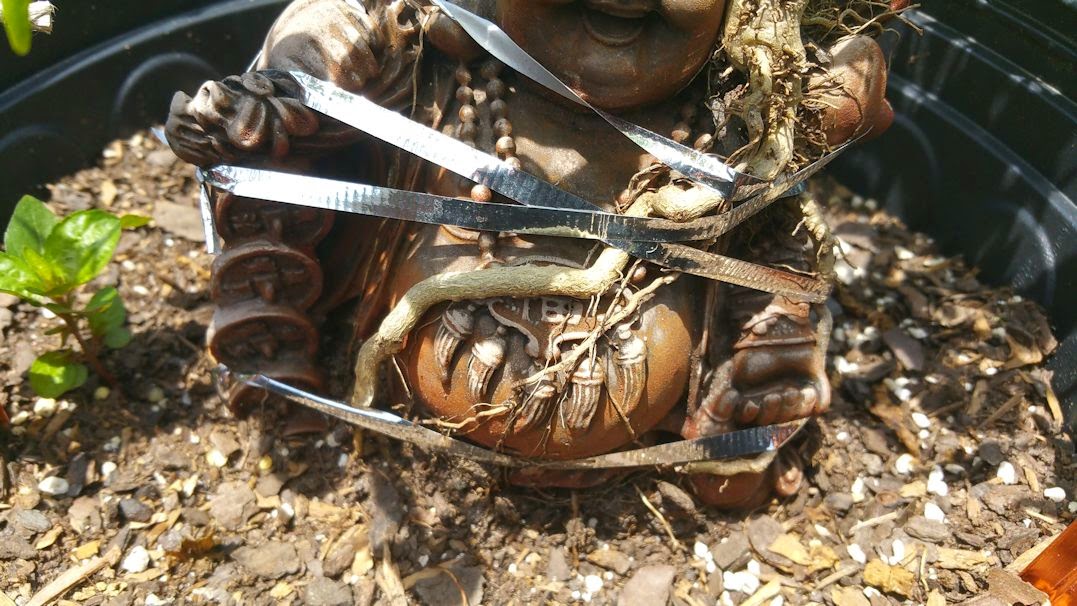
The main roots are nice, thick, and gripping the statue tightly.  Pulling on the trunk gets very little movement, so time to do some work on it.


This really illustrates the difference that the pull down makes on the nature of the roots.  The roots I exposed earlier are thick and woody, but even after all this time the roots that have been down in the soil are small and thin.  You can pretty clearly see where the soil line was just by the sudden transition in the root structure.

On a side note, I'm holding only the statue here, the pepper is gripping tightly enough to hold itself in place.  Thats excellent news.

Now, the next thing I did I didn't get pictures of, because it required both hands to do.  The roots you can see dangling beneath the statue in the previous picture?  I gathered them up and gentle twisted them under the base of the statue.  This pulled them all around under the bottom into a nice partial ball.

The reason for this is further insurance that the pepper keeps it's grip on the statue and can't be pulled off later.


After that had been done, I put it back in the pot, put some more soil in, and pressed firmly around the base in a diagonal direction, down and towards the center.  You can see the small trough this made around the base of the statue, this was again to press the roots up under the statue.  Then I put some more soil in to level everything out.

Once I've let it recover for about a week, I'll take a squirt bottle and knock the rest of the soil off the roots and start the last phase of pulldown on this one.  I'll pull it down to the base of the statue at the very least, and I may actually end up pulling it down even further by setting some spacers under the statue.  The reason for this would be to get the roots to fatten up under the statue to completely lock it in.  We'll see if thats needed in the following weeks.


And making it's transition into Bonchi-in-Progress is the *ONE* Cumari do Para pepper I got to germinate.  Must have tried a dozen seeds, only one ever came up.  Pretty unforgiving odds with these things, but everybody says they're great little semi-wild peppers, so I'm giving them a shot.

Putting it on the skull made of skulls I got in New Orleans earlier this year because I don't really have anything else to put them on at the moment.

Thursday, May 14, 2015

Slow Going

Its still slow and steady over here in bonchi land.


The one on the left in this picture is the one the skull is buried under, so of course its now the runt of the pack.


As you can see, I have it tied back and to the right with one of the tent pegs I first used on the Laughing Buddha bonchi.  Its a little hard to make out in this, but it is leaning over and then growing back up straight quite nicely, given it's small size.

If you recall, this pepper is sitting on top of the left eye socket (which would be on the right in this picture since it would be facing us if it weren't underground), so this bend would be pulling it further to the skull's left out away from center, and towards the back of it's head.  The next pull when it gets taller will be further back and to the left, to create a bit of a spiral to wreath the skull with.


As a comparison, here is one pepper right next to it, growing much taller.  Not sure exactly why that two peppers right next to each other would be having this noticeable of a growth difference, but considering all three of the non-skull peppers are doing better, I can only assume that it has something to do with the skull.  First thought would be that the skull pepper can't grow it's roots straight down, so it has a harder time getting away from the dryer surface layer, and hence not growing as quickly.

I'm not overly eager to try and water that end more than the others, because ideally the "its not getting as much water as the others" is exactly what we want.  It means that once the roots do fully grow out, they will keep trying to go deeper to get to the water, and will encircle the skull better.

I could dig it up and see for myself how the roots are going, work on repositioning things, but I'm trying not to right now because messing with any of them now would cause them to be delayed.  Once its bigger, I'll take a peek at how the roots are going just in case something needs moving around, but for now I'm just letting it do it's own thing.

Did give it a bit of extra fertilizer though, just in case.


Speaking (earlier) of the Laughing Buddha bonchi, here it is.  It has several pods on it, and I've decided to let them ripen.  That will dramatically slow the growth of new leaves and branches above ground as it diverts all of it's energy into fruit production, but the increased demands on the roots will really help things along.  As evidenced by this:


Those roots are getting nice and fat, exactly the way I wanted them to.

Wednesday, April 22, 2015

Low Stakes Bonchi

Okay, hasn't been any updates in a while because, honestly, there hasn't been much to update on until now.  I'm sure nobody wants to hear me talk just for the sake of hearing me talk.


So, whats the update about?  Tent stakes and jute twine, of course!  The Laughing Buddha Peter Pepper bonchi has been having a growth spurt, and has some nice long branches on it now.  Problem is, they're all going straight up, as peppers are want to do.  I however want this bonchi to have a nice canopy so that it looks like its shading Buddha underneath, and peppers are not known for growing low flat canopies.

Problem number two, I don't like wiring bonsai.  Sure, its great on bonsai trees that are rigid and have to be held in place for 6 months or even years at a time for them to hold their shape.  Its the only practical way of shaping the branches.  However, peppers are not trees.  Their green growth is very flexible, plus I'm not interested in tying the branches into knots, I just want them to be more lateral.  So, instead of spending all day trying to wire this thing again, I went for a... "less intricate" method.

I tied it down like a tent.


These are just super cheap aluminum tent spikes from Walmart that I had laying around, and some jute twine I bought from the craft department.  All I did was put the spikes down in the pot, loop the twine through them, and tied the branches down with a simple square knot.  If I cinched it a little too tight and pulled the branch too far down, I simply pulled the stake up a little bit until I got the branch angle I wanted.

Unlike trees, peppers can take this kind of extreme bending pretty easily with the new growth, although if you look closely you might see where I bent one a little too far and broke it off.  No worries though, it was a small branch and I found a suitable replacement for it anyway.  The biggest branch bent over easily, you can see it there quite well in the second picture.

Now I can just leave it like that for a while.  The limbs will start growing new branches pointing up again as the main branch lignifies to where it will hold it's shape on it's own, and then I can do the same thing to those new branches to get a nice flat bottomed canopy.  Added benefit, this jute twine is pretty thick, and not tightly coiled around the branches so it won't bite into them.  No worries about scarring the branch this way!

---

Other misc updates, the Reapers are still growing slowly.  We've had some nights of low 50's to upper 40's which will stall pepper growth, but I'm hoping some slowed above ground growth will help promote faster root growth as they try to dig down for some warmth.


I have no idea if thats true or not, but its a more productive line of thinking than "they're just sitting there doing nothing".

I'm also hoping to see good results from the tent pegs used above to use on the Reapers later.  I want a twisted trunk for the main Reaper bonchi, and tying it down with twine and stakes to pull it in the directions I want it to go is going to be a LOT easier than trying to wire it or digging it up to replant at an angle.


Also some disappointing results from the weird Halloween plant.  Thats it on the bottom there, and you can see its quite green now.  There's some black shading to the leaves, but they are no longer solid jet black.  Mixed bag though, because one of the others (the one that is unfortunately in the shadow of my phone) is now displaying more black on the leaves, while the two on the left (the free growing on the far left, and the one on the skull in the middle) have no black at all on their leaves.

Might still be worth trying to cross pollinate the two darker ones.  I might still be able to breed up some solid black ones, just doesn't look like I was lucky enough to get it for free in a single generation's worth of mutation.

Sunday, April 5, 2015

Spring Planting Time

Okay, our last frost date here is 4/1-4/10.  Last night we hit 36°F/2°C briefly, but the 10 day forecast calls for nothing but warm wet weather from here out, so lets plant us some bonsai peppers!

Alas, poor Yorick.  I knew him, Horatio...

Dug out our skull from it's storage spot since last time we saw him.

...he was an asshole and I'm glad he's dead.

Out in the raised bed, dug a nice hole big enough for the skull and just deep enough for the top of the skull to be just below the soil line.


Now this is where it gets more important what we're doing.  Here I've taken the biggest and strongest looking of the Reapers (sadly, it was not the zombie reaper, but it was one of my final 4), removed most of the soil, and found the main root.  Now while peppers don't have an actual taproot, they do have a main root which was the first to grow after the seed germinated.  The plant is going to try and grow it's roots in the direction that that root is going, so its important to find it and get it positioned where you want it to go, and the rest of the roots should more or less follow.


Here I've gotten the pepper and the roots laid out where I want them.  You can see I've gone for a location over the skull's left eye socket.  I decided I wanted this to be asymmetrical to keep it from looking too artificial.  Also pulled a good bit of roots out over the back of the skull as well, hopefully they will all fatten up enough to where it will get a good grip on it.


And here's where I did something a little bit stupid.  After I got everything in place I was pressing the soil down to compact it enough to hold everything in place where I wanted it, and I heard a crunching sound.  Pretty certain the glue on the hinge of that damned jaw broke again.  I would say that thing is fragile as glass, but that would be an insult to the glass.  Oh well, I'm not digging the whole thing up now.  Whatever condition its in when I dig it up later is the condition its going to be in for the bonchi.


And there we go, the raised bed now has the four best Reapers in it (along with a boarder of transylvanian garlic), and is being watched over by my disgruntled lawn gnome.  The one with the skull is on the far right, opposite end of the gnome, as that spot gets the most sun.

Oh, and if anyone is wondering, the reason I don't trim those clovers and things that are growing tall around the raised bed right now is because I also keep bees.  The bees love those flowers, so I'm letting them have 'em until the flowers fade.  When there's no more flowers to feed the bees with, then I'll cut it all down and toss it in my composter.

----

And while we're at it, updates on the other practice projects.


The Laughing Buddha Peter Pepper is doing well.  Its putting out lots of nice new growth, which I'm probably going to not wire again but tie down to get more of a canopy going.  Also likely going to move him back into a large container for the season to really let it go wild growing.  Only way to thicken those roots and trunk up to the max is to let the top grow as big as possible, so thats what we're going to do.


The oddball Halloween pepper continues to exhibit odd growth patterns.  Its putting out a cluster of leaves, but only from one side.  If nothing else, this should make an interesting bonchi simply because of how strange its growing.


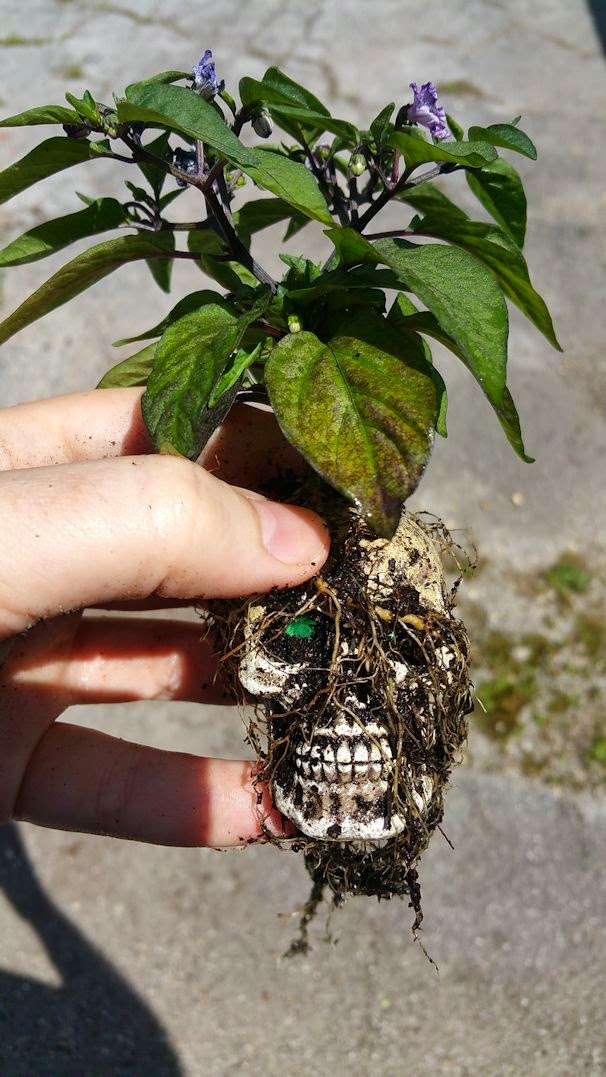
Speaking of the Halloween peppers, here's the one I planted on the small skull.  Washed the dirt off the roots, and look at that main root.  Just like I mentioned before, they'll all tend to have one root that is bigger and beefier than the others, which was the first root the seed grew.  If you look closely, you can see its got an interesting bendy shape due to it growing over the skull.


Some repositioning of roots, and making sure that nice big main root goes in an interesting place, and we're starting to look pretty good here.  I also balled the roots up a bit under the bottom of the skull to try and encourage them to stay there and fully enclose the skull to make it impossible to remove short of cutting it out.


After that, replanted everything.  You can see on the left where the top of the roots are still showing, then on the right where I just barely covered them (and pulled off a few low leaves to give it a little air at the trunk).


This is the one that I didn't do anything to other than let it grow.  As you can see, it has pods set already.  The mini skull one I went back and pruned off the wilting flowers (which most likely set fruit), but this one I will let go.  Why?  Because producing fruit requires a large investment of energy on the plant's part.  While its true that it also uses a lot of water and nutrients, which encourages root growth, overall it slows the plant down.  The skull pepper I want to put out as much vegetative growth (aka, leaves) as possible to build up the trunk, which in turn will cause thicker roots.  This one though, I'm letting it grow however it wants.  Later on I'll compare how it's roots came out to the others and see what we've got to work with.

Multiple plants, being treated in multiple different fashions.  Thats how you experiment and learn, do a lot of different things and see what works, and what doesn't.

Wednesday, April 1, 2015

Foliar Feeding Is A Scam

The new season is upon us, and I'm already seeing people talking about the same things again.  "I water and foliar feed my peppers every week!"

For those who aren't familiar with the practice, foliar feeding is the act of spraying diluted fertilizer directly onto the leaves of a plant.  Now, while this is a legitimate thing to do under certain circumstances (which I will explain below), for the most part this is a waste of your time and money.

Let me say that again:

Foliar feeding is a waste of your time and money!

Okay, lets get into why this is true.

The belief is that a plant will only absorb so much nutrients through it's roots, and that by spraying extra on the leaves you will supercharge the plant for even better results.  It is true that peppers and most other leafy plants are capable of absorbing both water and nutrients through their leaves.  However, the leaves were not "designed" for this, its more of an accident that it works at all than it is any intended function of the plant.

Like people, a plant has a limited set of needs for food and water.  Once met, no additional amount of food will make a difference.  Adding fertilizers to soil is good up until the point you reach the amount required by the plant, the amount that lets it get maximized growth.  Everything beyond that is wasted, the roots won't take it up because the plant doesn't need it.  Its much like with people, I don't care how hungry you are, you couldn't actually eat an entire grocery store full of food in one sitting if you tried.

Yet people think that by bypassing the roots, they can force a plant to take up more nutrients than it needs, and that this will somehow make it healthier.  Again, it is possible for a pepper (or any leafy vegetable) to absorb some nutrients through it's leaves.  Just like its possible for a human to absorb alcohol through their skin.  Doesn't mean everybody should run out and get martini patches.  A healthy root system will take up those nutrients faster and more efficiently than the leaves ever could, and will direct those nutrients directly to where they are needed by the plant.

So what are the circumstances when foliar feeding isn't a waste of your time?

You should foliar feed whenever a plant does not have a healthy root system and is hence incapable of absorbing water and nutrients through it's roots.  This would include when you're trying to make a cuttings, or when your plant has extensive root rot and you are trying to make a last ditch effort to save it.

Thats it.

In absolutely any scenario where the roots are healthy, foliar feeding is not necessary, and may actually end up hurting your plant if you do it wrong (there are diseases and molds/fungus that thrive on constantly damp leaves).

So why can you find foliar feed sprays at the store these days?  Well simply put, Miracle Grow smelled money.  This started up as a fad a while back, and the fertilizer companies realized that they could repackage what they already make in a watered down form, and sell it to people at full price.  Kind of like how Coca Cola sells you bottled water that is the same stuff they put in the soda, minus the expensive syrup, and sells it to you for as much if not more than a bottle of coke.  They saw a market, and instead of saying "this isn't actually something you need to do", they only saw "this is something you will pay for" and went for it.

Do not waste your money buying foliar sprays.  Do not waste your time making your own.  Do not waste your time spraying dilute fertilizer on your plants' leaves.  Just pour it in the soil.  If your plant needs the extra food, it will take it up naturally.  If it doesn't need the extra food, then you shouldn't be fertilizing it to start with.